By Ryan Teeples
For over a quarter-century, BYU has found regular-season basketball success, even transitioning into winning ways in the toughest basketball conference in the country. Yet the Cougs remain a statistical anomaly in the postseason.
While the program frequently earns “protected” seeds, they have become the nation’s most predictable loser in the Big Dance to double-digit underdogs. And their performance the last millennium is a case-study in massive under-achievement.
In fact, there’s no way to make a case other than the BYU Cougars being the worst performing post-season team of the last 26 years–by a very long shot.
BYU vs. NCAA Field: Round of 64 Performance
Here’s how the Cougs have performed since 2000, as compared to what that seed traditionally accomplishes on average.

Data excludes “First Four” play-in games to focus on the Round of 64 bracket. Can we please stop pretending being in a play-in game is being in the tournament? It’s silly.
Is BYU the Worst?
When compared to other frequent flyers (teams with 12+ appearances since 2000), BYU is statistically the worst-performing program in the modern era. While programs like Purdue or Virginia have suffered more “famous” upsets, they possess Final Fours or Elite Eights to justify their high seeds. BYU is the only program that consistently earns Top-8 seeds but fails to advance past the first weekend in 85% of its attempts.
The data suggests a systemic “Margin of Softness.” While their losses as high seeds are often close (avg. -7.5 as a 6-seed), they lack the closing instinct of their peers. Conversely, when BYU plays as an underdog, they suffer blowouts far worse than the national average (-17.5 vs. -11.8). Essentially, BYU represents the “anti-Cinderella”—a team that looks like a powerhouse in February but becomes a statistical gift to the field in March.
It gets even worse than it sounds so far.
Season-by-Season Performance vs. Expectation

The “Average” Alternate Reality
If BYU had performed as a perfectly average program based on their seedings since 2000, their trophy case would look significantly different:
- Round of 64 Wins: BYU has 3; an average team would have 9.
- Sweet 16 Appearances: BYU has 2; an average team would have 4.
- Elite Eights: BYU has 0; an average team would have a 45% chance of at least one.
- Win Rate as Higher Seed: BYU is 30.0%; the NCAA average is 64.0%.
- Win Rate as Lower Seed: BYU is 0.0%; the NCAA average is 36.5%.
BYU should have TRIPLE the wins in the NCAA tournament it has
If BYU had performed exactly like the historical average for their seeds, here is how many wins they “should” have collected across their 13 main-bracket appearances. To find the “Expected” wins, we use the historical winning percentages of each specific seed from the Round of 64 through the National Championship.
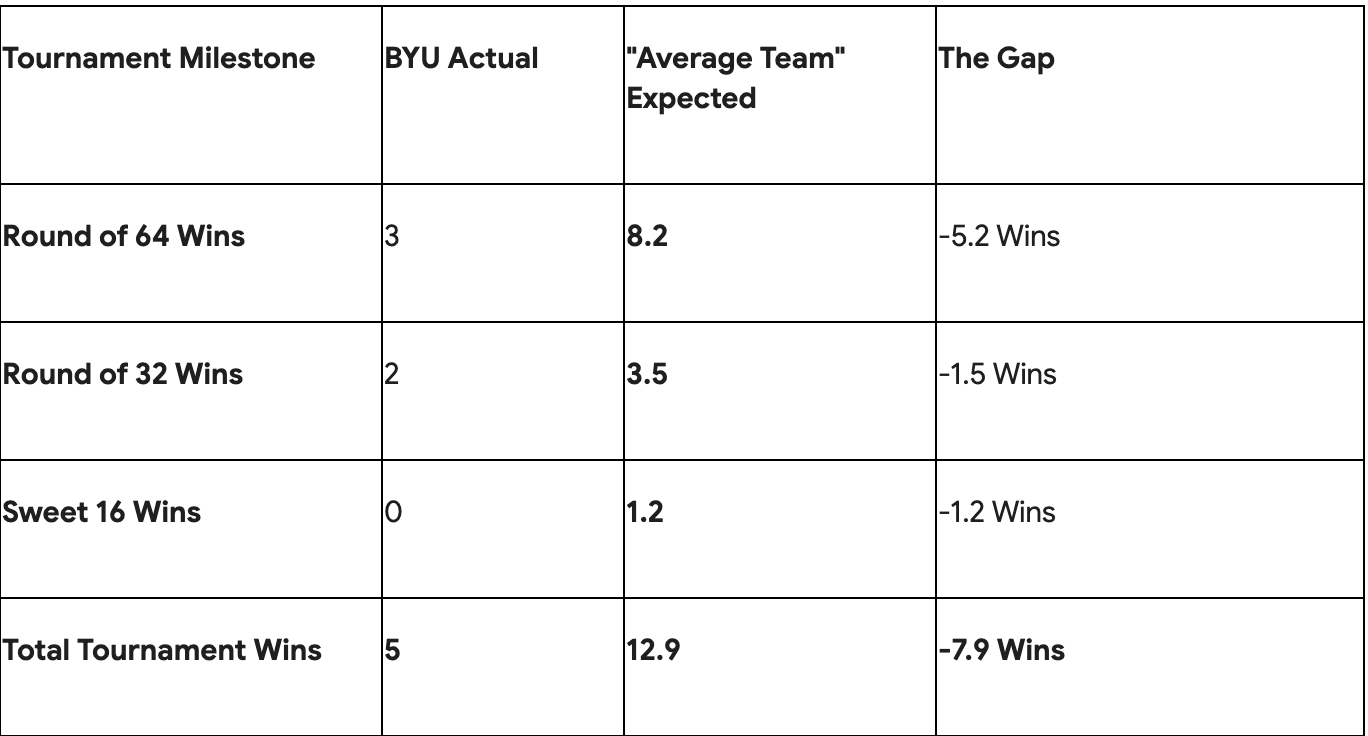
An average team with BYU’s seeds would have nearly triple the total wins and roughly 8 first-round victories. Instead, BYU has left nearly 8 total wins over the last 26 years on the table.
Deep Run Probability
While fans hope for deep runs, the math shows that BYU’s specific seeds (mostly 6s, 8s, and 12s) don’t typically yield Final Fours. However, they should have made it further than they have:
- Elite Eights: BYU has 0 in this span. An average team with their seeds would have a 48% cumulative chance of having reached at least one Elite Eight by now.
- Sweet Sixteens: BYU has 2 (2011, 2025). An average team would be expected to have reached 3 or 4.
- The “Favorite” Failure: BYU has been the higher seed (the favorite) in 10 Round of 64 games since 2000. They have won only 3 of those. A statistically average team would have won 7.
Someone else has to be worse. Right? Right?
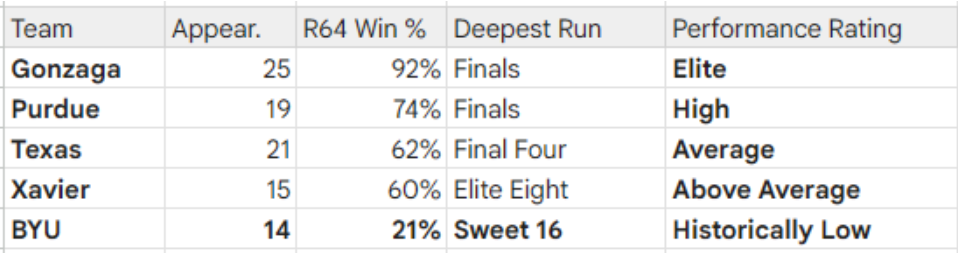
To determine this, we compare BYU to other programs with at least 12 appearances in the same 2000–2026 window that have also never reached a Final Four.
Among all “high-frequency” tournament teams, BYU is statistically BY FAR the worst performer relative to their seed. They are the only team in this tier that wins fewer than 25% of their opening games. While other teams have “bad losses” (like Purdue losing to a 16-seed), they compensate with deep runs. BYU has the “bad losses” without the high-end success to offset them.
It gets even worse when you look at margin of victory!
- Average Margin of Victory: In their few wins, BYU wins by an average of +8.0. This is slightly below the NCAA seed average of +9.8, meaning even when they win, they struggle to dominate.
- Average Margin of Loss: In their many losses, BYU loses by an average of -9.8. However, in the #6 seed vs. #11 seed matchup—BYU’s most frequent slot lately—their losses are usually “heartbreakers” (avg. -6.2), suggesting a recurring failure to execute in the final two minutes of close games.
So where do fans, staff, bettors go from here? No idea. But there’s no way to polish the turd that is BYU hoops in March.